Showing posts with label Informations. Show all posts

Wednesday, December 23, 2015

Electricity definition

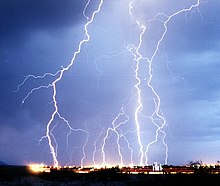
Multiple lightning strikes on a city at night
Lightning is one of the most dramatic effects of electricity.
Electricity is the set of physical phenomena associated with the presence and flow of electric charge. Electricity gives a wide variety of well-known effects, such as lightning,static electricity, electromagnetic induction and electric current. In addition, electricity permits the creation and reception of electromagnetic radiation such as radio waves.
In electricity, charges produce electromagnetic fields which act on other charges. Electricity occurs due to several types of physics:
  • electric charge: a property of some subatomic particles, which determines their electromagnetic interactions. Electrically charged matter is influenced by, and produces, electromagnetic fields.
  • electric field (see electrostatics): an especially simple type of electromagnetic field produced by an electric charge even when it is not moving (i.e., there is no electric current). The electric field produces a force on other charges in its vicinity.
  • electric potential: the capacity of an electric field to do work on an electric charge, typically measured in volts.
  • electric current: a movement or flow of electrically charged particles, typically measured in amperes.
  • electromagnets: Moving charges produce a magnetic field. Electric currents generate magnetic fields, and changing magnetic fields generate electric currents.
In electrical engineering, electricity is used for:
  • electric power where electric current is used to energise equipment;
  • electronics which deals with electrical circuits that involve active electrical components such as vacuum tubes, transistors, diodes and integrated circuits, and associated passive interconnection technologies.
Electrical phenomena have been studied since antiquity, though progress in theoretical understanding remained slow until the seventeenth and eighteenth centuries. Even then, practical applications for electricity were few, and it would not be until the late nineteenth century that engineers were able to put it to industrial and residential use. The rapid expansion in electrical technology at this time transformed industry and society. Electricity's extraordinary versatility means it can be put to an almost limitless set of applications which include transport, heating, lighting, communications, and computation. Electrical power is now the backbone of modern industrial society.

Gas definition

This article is about the physical properties of gas as a state of matter. 
Gas phase particles (atoms,molecules, or ions) move around freely in the absence of an applied electric field.
Gas is one of the four fundamental states of matter (the others being solid, liquid, and plasma). A pure gas may be made up of individual atoms (e.g. a noble gas like neon),elemental molecules made from one type of atom (e.g. oxygen), or compound molecules made from a variety of atoms (e.g. carbon dioxide). A gas mixture would contain a variety of pure gases much like the air. What distinguishes a gas from liquids and solids is the vast separation of the individual gas particles. This separation usually makes a colorless gas invisible to the human observer. The interaction of gas particles in the presence of electric and gravitational fields are considered negligible as indicated by the constant velocity vectors in the image. One type of commonly known gas is steam.
The gaseous state of matter is found between the liquid and plasma states, the latter of which provides the upper temperature boundary for gases. Bounding the lower end of the temperature scale lie degenerative quantum gases which are gaining increasing attention. High-density atomic gases super cooled to incredibly low temperatures are classified by their statistical behavior as either a Bose gas or a Fermi gas. For a comprehensive listing of these exotic states of matter see list of states of matter.

Types of software

UserApplicationOperating SystemHardware
A diagram showing how theoperating system software andapplication software are layered on a typical desktop computer. The arrows indicate information flow.
On virtually all computer platforms, software can be grouped into a few broad categories.

Purpose, or domain of use

Based on the goal, computer software can be divided into:
  • Application software, which is software that uses the computer system to perform special functions or provide entertainment functions beyond the basic operation of the computer itself. There are many different types of application software, because the range of tasks that can be performed with a modern computer is so large—see list of software.
  • System software, which is software that directly operates the computer hardware, to provide basic functionality needed by users and other software, and to provide a platform for running application software.[2] System software includes:
    • Operating systems, which are essential collections of software that manage resources and provides common services for other software that runs "on top" of them.Supervisory programs, boot loaders, shells and window systems are core parts of operating systems. In practice, an operating system comes bundled with additional software (including application software) so that a user can potentially do some work with a computer that only has an operating system.
    • Device drivers, which operate or control a particular type of device that is attached to a computer. Each device needs at least one corresponding device driver; because a computer typically has at minimum at least one input device and at least one output device, a computer typically needs more than one device driver.
    • Utilities, which are computer programs designed to assist users in maintenance and care of their computers.
  • Malicious software or malware, which is software that is developed to harm and disrupt computers. As such, malware is undesirable. Malware is closely associated with computer-related crimes, though some malicious programs may have been designed as practical jokes.

Nature or domain of execution

  • Desktop applications such as web browsers and Microsoft Office, as well as smartphone and tablet applications (called "apps"). (There is a push in some parts of the software industry to merge desktop applications with mobile apps, to some extent. Windows 8, and later Ubuntu Touch, tried to allow the same style of application user interface to be used on desktops, laptops and mobiles.)
  • JavaScript scripts are pieces of software traditionally embedded in web pages that are run directly inside the web browser when a web page is loaded without the need for a web browser plugin. Software written in other programming languages can also be run within the web browser if the software is either translated into JavaScript, or if a web browser plugin that supports that language is installed; the most common example of the latter is ActionScript scripts, which are supported by the Adobe Flash plugin.
  • Server software, including:
    • Web applications, which usually run on the web server and output dynamically generated web pages to web browsers, using e.g. PHP, Java or ASP.NET, or even JavaScript that runs on the server. In modern times these commonly include some JavaScript to be run in the web browser as well, in which case they typically run partly on the server, partly in the web browser.
  • Plugins and extensions are software that extends or modifies the functionality of another piece of software, and require that software be used in order to function;
  • Embedded software resides as firmware within embedded systems, devices dedicated to a single use or a few uses such as cars and televisions (although some embedded devices such as wireless chipsets canthemselves be part of an ordinary, non-embedded computer system such as a PC or smartphone).In the embedded system context there is sometimes no clear distinction between the system software and the application software. However, some embedded systems run embedded operating systems, and these systems do retain the distinction between system software and application software (although typically there will only be one, fixed, application which is always ran).
  • Microcode is a special, relatively obscure type of embedded software which tells the processor itself how to execute machine code, so it is actually a lower level than machine code. It is typically proprietary to the processor manufacturer, and any necessary correctional microcode software updates are supplied by them to users (which is much cheaper than shipping replacement processor hardware). Thus an ordinary programmer would not expect to ever have to deal with it.

Programming tools

Programming tools are also software in the form of programs or applications that software developers (also known as programmers, coders, hackers or software engineers) use to create, debug, maintain (i.e. improve or fix), or otherwise support software. Software is written in one or more programming languages; there are many programming languages in existence, and each has at least one implementation, each of which consists of its own set of programming tools. These tools may be relatively self-contained programs such as compilers, debuggers, interpreters, linkers, and text editors, that can be combined together to accomplish a task; or they may form an integrated development environment (IDE), which combines much or all of the functionality of such self-contained tools. IDEs may do this by either invoking the relevant individual tools or by re-implementing their functionality in a new way. An IDE can make it easier to do specific tasks, such as searching in files in a particular project. Many programming language implementations provide the option of using both individual tools or an IDE.

Software definition

Computer software or simply software is any set of instructions that directs a computer to perform specific operations. Computer software consists of computer programs, libraries and related non-executable data(such as online documentation or digital media). Computer software is non-tangible, contrasted with computer hardware, which is the physical component of computers. Computer hardware and software require each other and neither can be realistically used without the other.
At the lowest level, executable code consists of machine language instructions specific to an individual processor—typically a central processing unit (CPU). A machine language consists of groups of binary values signifying processor instructions that change the state of the computer from its preceding state. For example, an instruction may change the value stored in a particular storage location inside the computer—an effect that is not directly observable to the user. An instruction may also (indirectly) cause something to appear on a display of the computer system—a state change which should be visible to the user. The processor carries out the instructions in the order they are provided, unless it is instructed to "jump" to a different instruction, or interrupted.
Software written in a machine language is known as "machine code". However, in practice, software is usually written in high-level programming languages that are easier and more efficient for humans to use (closer to natural language) than machine language. High-level languages are translated into machine language using a compiler or an interpreter or a combination of the two. Software may also be written in a low-levelassembly language, essentially, a vaguely mnemonic representation of a machine language using a natural language alphabet. Assembly language is translated into machine language using an assembler.

Saturday, December 19, 2015

Trading in finance

See original image
trader is person or entity, in finance, who buys and sells financial instruments such as stocksbondscommodities and derivatives, in the capacity of agent, hedgerarbitrageur, or speculator. According to the Wall Street Journal in 2004, a managing director convertible bond trader was earning between $700,000 and $900,000 on average

Duties and types

Traders are either professionals (institutional) working in a financial institution or a corporation, or individual (retail). They buy and sell financial instruments traded in the stock markets, derivatives markets and commodity markets, comprising the stock exchanges, derivatives exchanges and the commodities exchanges. Several categories and designations for diverse kinds of traders are found in finance, these may include:
  • Day trader
  • Floor trader
  • High-frequency trader
  • Pattern day trader
  • Rogue trader
  • Stock trader

Trading definition


A trader in Germany, 16th century

A San Juan de Dios Market inGuadalajara, Jalisco.

Trade
 involves the transfer of the ownership of goods or services from one person or entity to another in exchange for other goods or services or for money. Possible synonyms of "trade" include "commerce" and "financial transaction". A network that allows trade is called a market.
The original form of trade, barter, saw the direct exchange of goods and services for other goods and services.[1] Barter is trading things without the use of money.Later one side of the barter started to involve precious metals, which gained symbolic as well as practical importance. Modern traders generally negotiate through a medium of exchange, such as money. As a result, buying can be separated from selling, or earning. The invention of money (and later credit, paper money and non-physical money) greatly simplified and promoted trade. Trade between two traders is called bilateral trade, while trade between more than two traders is called multilateral trade.
Trade exists due to the specialization and division of labor, in which most people concentrate on a small aspect of production, trading for other products.Trade exists between regions because different regions may have a comparative advantage(perceived or real) in the production of some trade-able commodity, or because different regions' size may encourage mass production. As such, trade at market prices between locations can benefit both locations.
Retail trade consists of the sale of goods or merchandise from a very fixed location, such as a department store, boutique or kiosk,online or by mail, in small or individual lots for direct consumption or use by the purchaser.Wholesale trade is defined as the sale of goods that are sold as merchandise to retailers, and/or industrial, commercial, institutional, or other professional businessusers, or to other wholesalers and related subordinated service

Thursday, December 17, 2015

Claims Conference


The Conference on Jewish Material Claims Against Germany, or Claims Conference, represents world Jewry in negotiating for compensation and restitution for victims of Nazi persecution and their heirs. The Claims Conference administers compensation funds, recovers unclaimed Jewish property, and allocates funds to institutions that provide social welfare services to Holocaust survivors and preserve the memory and lessons of the Shoah.

Types of hosting

Many large companies that are not Internet service providers need to be permanently connected to the web to send email, files, etc. to other sites. The company may use the computer as a website host to provide details of their goods and services and facilities for online orders.
  • Free web hosting service: offered by different companies with limited services, sometimes supported by advertisements, and often limited when compared to paid hosting.
  • Shared web hosting service: one's website is placed on the same server as many other sites, ranging from a few sites to hundreds of websites. Typically, all domains may share a common pool of server resources, such as RAM and the CPU. The features available with this type of service can be quite basic and not flexible in terms of software and updates. Resellers often sell shared web hosting and web companies often have reseller accounts to provide hosting for clients.
  • Reseller web hosting: allows clients to become web hosts themselves. Resellers could function, for individual domains, under any combination of these listed types of hosting, depending on who they are affiliated with as a reseller. Resellers' accounts may vary tremendously in size: they may have their own virtual dedicated server to a colocated server. Many resellers provide a nearly identical service to their provider's shared hosting plan and provide the technical support themselves.
  • Virtual Dedicated Server: also known as a Virtual Private Server (VPS), divides server resources into virtual servers, where resources can be allocated in a way that does not directly reflect the underlying hardware. VPS will often be allocated resources based on a one server to many VPSs relationship, however virtualisation may be done for a number of reasons, including the ability to move a VPS container between servers. The users may have root access to their own virtual space. Customers are sometimes responsible for patching and maintaining the server (unmanaged server) or the VPS provider may provide server admin tasks for the customer (managed server).
  • Dedicated hosting service: the user gets his or her own Web server and gains full control over it (user has root access for Linux/administrator access for Windows); however, the user typically does not own the server. One type of dedicated hosting is self-managed or unmanaged. This is usually the least expensive for dedicated plans. The user has full administrative access to the server, which means the client is responsible for the security and maintenance of his own dedicated server.
  • Managed hosting service: the user gets his or her own Web server but is not allowed full control over it (user is denied root access for Linux/administrator access for Windows); however, they are allowed to manage their data via FTP or other remote management tools. The user is disallowed full control so that the provider can guarantee quality of service by not allowing the user to modify the server or potentially create configuration problems. The user typically does not own the server. The server is leased to the client.
  • Colocation web hosting service: similar to the dedicated web hosting service, but the user owns the colo server; the hosting company provides physical space that the server takes up and takes care of the server. This is the most powerful and expensive type of web hosting service. In most cases, the colocation provider may provide little to no support directly for their client's machine, providing only the electrical, Internet access, and storage facilities for the server. In most cases for colo, the client would have his own administrator visit the data center on site to do any hardware upgrades or changes. Formerly, many colocation providers would accept any system configuration for hosting, even ones housed in desktop-style minitower cases, but most hosts now require rack mount enclosures and standard system configurations.
  • Cloud hosting: is a new type of hosting platform that allows customers powerful, scalable and reliable hosting based on clustered load-balanced servers and utility billing. A cloud hosted website may be more reliable than alternatives since other computers in the cloud can compensate when a single piece of hardware goes down. Also, local power disruptions or even natural disasters are less problematic for cloud hosted sites, as cloud hosting is decentralized. Cloud hosting also allows providers to charge users only for resources consumed by the user, rather than a flat fee for the amount the user expects they will use, or a fixed cost upfront hardware investment. Alternatively, the lack of centralization may give users less control on where their data is located which could be a problem for users with data security or privacyconcerns.
  • Clustered hosting: having multiple servers hosting the same content for better resource utilization. Clustered servers are a perfect solution for high-availability dedicated hosting, or creating a scalable web hosting solution. A cluster may separate web serving from database hosting capability. (Usually web hosts use clustered hosting for their shared hosting plans, as there are multiple benefits to the mass managing of clients).Grid hosting: this form of distributed hosting is when a server cluster acts like a grid and is composed of multiple nodes.
  • Home server: usually a single machine placed in a private residence can be used to host one or more web sites from a usually consumer-grade broadband connection. These can be purpose-built machines or more commonly old PCs. Some ISPs actively attempt to block home servers by disallowing incoming requests to TCP port 80 of the user's connection and by refusing to provide static IP addresses. A common way to attain a reliable DNS host name is by creating an account with a dynamic DNS service. A dynamic DNS service will automatically change the IP address that a URL points to when the IP address changes.

Web hosting service

web hosting service is a type of Internet hosting service that allows individuals and organizations to make their website accessible via the World Wide Web. Web hosts are companies that provide space on a server owned or leased for use by clients, as well as providing Internet connectivity, typically in a data center. Web hosts can also provide data center space and connectivity to the Internet for other servers located in their data center, called colocation, also known as Housing in Latin America or France.
The scope of web hosting services varies greatly. The most basic is web page and small-scale file hosting, where files can be uploaded via File Transfer Protocol (FTP) or a Web interface. The files are usually delivered to the Web "as is" or with minimal processing. Many Internet service providers (ISPs) offer this service free to subscribers. Individuals and organizations may also obtain Web page hosting from alternative service providers. Personal web site hosting is typically free, advertisement-sponsored, or inexpensive. Business web site hosting often has a higher expense depending upon the size and type of the site.
Single page hosting is generally sufficient for personal web pages. A complex site calls for a more comprehensive package that provides database support and application development platforms (e.g. PHP, Java, Ruby on Rails, ColdFusion, or ASP.NET). These facilities allow customers to write or install scripts for applications like forums andcontent management. Also, Secure Sockets Layer (SSL) is typically used for websites that wish to keep the data transmitted more secure.
The host may also provide an interface or control panel for managing the Web server and installing scripts, as well as other modules and service applications like e-mail. A web server that does not use a control panel for managing the hosting account, is often referred to as a "headless" server. Some hosts specialize in certain software or services (e.g. e-commerce, blogs, etc.).

Hosting defintion


Hosting can mean: Act as host at (an event) or for (a television or radio program); or to store (a Web site or other electronic data) on a computer connected to the Internet.

Online degree

An online degree is an academic degree (usually a college degree, but sometimes the term includes high school diplomas and non-degree certificate programs) that can be earned primarily or entirely through the use of an Internet-connected computer, rather than attending college in a traditional campus setting. Improvements in technology, the increasing use of the Internet worldwide, and the need for people to have flexible school schedules that enable them to work while attending school have led to a proliferation of online colleges that award associate's, bachelor's, master's, and doctoral degrees.

Academic degree definition

An academic degree is the state of recognized completion of studies at a school or university. A diploma is generally issued in recognition of having satisfactorily completed the prescribed course of study. The two most common degrees awarded today are associate and bachelor's.

Donation definition


donation is a gift given by physical or legal persons, typically for charitable purposes and/or to benefit a cause. A donation may take various forms, including cashofferingservices, new or used goods including clothingtoysfood, and vehicles. It also may consist of emergency, relief or humanitarian aid items, development aid support, and can also relate to medical care needs as i.e. blood or organs for transplant. Charitable gifts of goods or services are also called gifts in kind.

Donating in the name of others

It is possible to donate in the name of a third party, making a gift in honor or in memory of someone or something. Gifts in honor or memory of a third party are made for various reasons, such as holiday gifts, wedding gifts, in memory of somebody who has died, in memory of pets or in the name of groups or associations no longer existing. Memorial gifts are sometimes requested by their survivors (e.g. "in lieu of flowers, contributions may be made to ABC Charity"), usually directing donations to a charitable organization for which the deceased was a donor or volunteer, or for a cause befitting the deceased's priorities in life or manner of death. Memorial donations are also sometimes given by people if they are unable to attend the ceremony.

Tuesday, December 15, 2015

Lawyer education


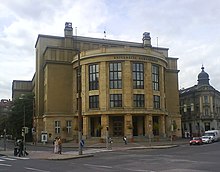
Law Faculty of Comenius Universityin Bratislava (Slovakia).
The educational prerequisites for becoming a lawyer vary greatly from country to country. In some countries, law is taught by a faculty of law, which is a department of a university's general undergraduate college. Law students in those countries pursue a Master or Bachelor of Laws degree. In some countries it is common or even required for students to earn another bachelor's degree at the same time. Nor is the LL.B the sole obstacle; it is often followed by a series of advanced examinations, apprenticeships, and additional coursework at special government institutes.
In other countries, particularly the UK and USA, law is primarily taught at law schools. In America, the American Bar Association decides which law schools to approve and thereby which ones are deemed most respectable.In England and Wales,the Bar Professional Training Course (BPTC) must be taken to have the right to work and be named as a barrister. In the United States[ and countries following the American model, (such as Canada with the exception of the province of Quebec) law schools are graduate/professional schools where a bachelor's degree is a prerequisite for admission. Most law schools are part of universities but a few are independent institutions. Law schools in the United States (and a few in Canada, where an LL.B or LL.M degree is much more common, and elsewhere) award graduating students a J.D. (Juris Doctor/Doctor of Jurisprudence) (as opposed to the Bachelor of Laws) as the practitioner's law degree. Many schools also offer post-doctoral law degrees such as the LL.M (Legum Magister/Master of Laws), or the S.J.D. (Scientiae Juridicae Doctor/Doctor of Juridical Science) for students interested in advancing their research knowledge and credentials in a specific area of law.
The methods and quality of legal education vary widely. Some countries require extensive clinical training in the form of apprenticeships or special clinical courses.Others, like Venezuela, do not.A few countries prefer to teach through assigned readings of judicial opinions (the casebook method) followed by intense in-class cross-examination by the professor (the Socratic method).Many others have only lectures on highly abstract legal doctrines, which forces young lawyers to figure out how to actually think and write like a lawyer at their first apprenticeship (or job).Depending upon the country, a typical class size could range from five students in a seminar to five hundred in a giant lecture room. In the United States, law schools maintain small class sizes, and as such, grant admissions on a more limited and competitive basis.
Some countries, particularly industrialized ones, have a traditional preference for full-time law programs,while in developing countries, students often work full- or part-time to pay the tuition and fees of their part-time law programs.
Law schools in developing countries share several common problems, such as an over reliance on practicing judges and lawyers who treat teaching as a part-time hobby (and a concomitant scarcity of full-time law professors);incompetent faculty with questionable credentials;and textbooks that lag behind the current state of the law by two or three decades.

Earning the right to practice law

Some jurisdictions grant a "diploma privilege" to certain institutions, so that merely earning a degree or credential from those institutions is the primary qualification for practicing law.Mexico allows anyone with a law degree to practice lawHowever, in a large number of countries, a law student must pass a bar examination (or a series of such examinations) before receiving a license to practice. In a handful ofU.S. states, one may become an attorney (a so-called country lawyer) by simply "reading law" and passing the bar examination, without having to attend law school first (although very few people actually become lawyers that way). In other states, the bar examination can be very challenging, such as in California where only 42.3% of applicants passed the examination administered in February 2011.
Some countries require a formal apprenticeship with an experienced practitioner, while others do not.For example, a few jurisdictions still allow an apprenticeship in place of any kind of formal legal education (though the number of persons who actually become lawyers that way is increasingly rare).

Lawyer Responsibilities

In most countries, particularly civil law countries, there has been a tradition of giving many legal tasks to a variety of civil law notaries, clerks, and scriveners. These countries do not have "lawyers" in the American sense, insofar as that term refers to a single type of general-purpose legal services provider; rather, their legal professions consist of a large number of different kinds of law-trained persons, known asjurists, some of whom are advocates who are licensed to practice in the courts. It is difficult to formulate accurate generalizations that cover all the countries with multiple legal professions, because each country has traditionally had its own peculiar method of dividing up legal work among all its different types of legal professionals.
Notably, England, the mother of the common law jurisdictions, emerged from the Dark Ages with similar complexity in its legal professions, but then evolved by the 19th century to a single dichotomy between barristers and solicitors. An equivalent dichotomy developed between advocates and procurators in some civil law countries; these two types did not always monopolize the practice of law, in that they coexisted with civil law notaries.
Several countries that originally had two or more legal professions have since fused or united their professions into a single type of lawyer. Most countries in this category are common law countries, though France, a civil law country, merged its jurists in 1990 and 1991 in response to Anglo-American competition.In countries with fused professions, a lawyer is usually permitted to carry out all or nearly all the responsibilities listed below.

Oral argument in the courts
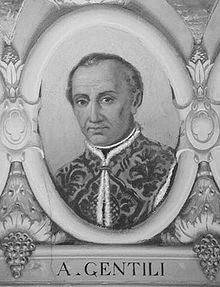
Dr Alberico Gentili (1552-1608), one of the best known lawyers.
Arguing a client's case before a judge or jury in a court of law is the traditional province of the barrister in England, and of advocates in some civil law jurisdictions.However, the boundary between barristers and solicitors have evolved. In England today, the barrister monopoly covers only appellate courts, and barristers must compete directly with solicitors in many trial courts. In countries like the United States, that have fused legal professions, there are trial lawyers who specialize in trying cases in court, but trial lawyers do not have a de jure monopoly like barristers. In some countries, litigants have the option of arguing pro se, or on their own behalf. It is common for litigants to appear unrepresented before certain courts like small claims courts; indeed, many such courts do not allow lawyers to speak for their clients, in an effort to save money for all participants in a small case.In other countries, like Venezuela or Portugal, no one may appear before a judge unless represented by a lawyer.The advantage of the latter regime is that lawyers are familiar with the court's customs and procedures, and make the legal system more efficient for all involved. Unrepres

Research and drafting of court papers

Often, lawyers brief a court in writing on the issues in a case before the issues can be orally argued. They may have to perform extensive research into relevant facts and law while drafting legal papers and preparing for oral argument.
In England, the usual division of labor is that a solicitor will obtain the facts of the case from the client and then brief a barrister (usually in writing). The barrister then researches and drafts the necessary court pleadings (which will be filed and served by the solicitor) and orally argues the case.
In Spain, the procurator merely signs and presents the papers to the court, but it is the advocate who drafts the papers and argues the case.
In some countries, like Japan, a scrivener or clerk may fill out court forms and draft simple papers for lay persons who cannot afford or do not need attorneys, and advise them on how to manage and argue their own cases.

Advocacy (written and oral) in administrative hearings

In most developed countries, the legislature has granted original jurisdiction over highly technical matters to executive branch administrative agencies which oversee such things. As a result, some lawyers have become specialists in administrative law. In a few countries, there is a special category of jurists with a monopoly over this form of advocacy; for example, France formerly had conseils juridiques (who were merged into the main legal profession in 1991).In other countries, like the United States, lawyers have been effectively barred by statute from certain types of administrative hearings in order to preserve their informality.

Client intake and counseling (with regard to pending litigation)

An important aspect of a lawyer's job is developing and managing relationships with clients (or the client's employees, if the lawyer works in-house for a government or corporation). The client-lawyer relationship often begins with an intake interview where the lawyer gets to know the client personally, discovers the facts of the client's case, clarifies what the client wants to accomplish, shapes the client's expectations as to what actually can be accomplished, begins to develop various claims or defenses, and explains her or his fees to the client.
In England, only solicitors were traditionally in direct contact with the client. The solicitor retained a barrister if one was necessary and acted as an intermediary between the barrister and the client.[39] In most cases barristers were obliged, under what is known as the "cab rank rule", to accept instructions for a case in an area in which they held themselves out as practising, at a court at which they normally appeared and at their usual rates.

Legal advice


Legal advice is the application of abstract principles of law to the concrete facts of the client's case in order to advise the client about what they should do next. In many countries, only a properly licensed lawyer may provide legal advice to clients for good consideration, even if no lawsuit is contemplated or is in progress.Therefore, even conveyancers and corporate in-house counsel must first get a license to practice, though they may actually spend very little of their careers in court. Failure to obey such a rule is the crime of unauthorized practice of law.
In other countries, jurists who hold law degrees are allowed to provide legal advice to individuals or to corporations, and it is irrelevant if they lack a license and cannot appear in court.Some countries go further; in England and Wales, there is no general prohibition on the giving of legal advice.Sometimes civil law notaries are allowed to give legal advice, as in Belgium. In many countries, non-jurist accountants may provide what is technically legal advice in tax and accounting matters.

Protecting intellectual property

In virtually all countries, patents, trademarks, industrial designs and other forms of intellectual property must be formally registered with a government agency in order to receive maximum protection under the law. The division of such work among lawyers, licensed non-lawyer jurists/agents, and ordinary clerks or scriveners varies greatly from one country to the next.

Negotiating and drafting contracts

In some countries, the negotiating and drafting of contracts is considered to be similar to the provision of legal advice, so that it is subject to the licensing requirement explained above. In others, jurists or notaries may negotiate or draft contracts.
Lawyers in some civil law countries traditionally deprecated "transactional law" or "business law" as beneath them. French law firms developed transactional departments only in the 1990s when they started to lose business to international firms based in the United States and the United Kingdom (where solicitors have always done transactional work).

Conveyancing

Conveyancing is the drafting of the documents necessary for the transfer of real property, such as deeds and mortgages. In some jurisdictions, all real estate transactions must be carried out by a lawyer (or a solicitor where that distinction still exists).Such a monopoly is quite valuable from the lawyer's point of view; historically, conveyancing accounted for about half of English solicitors' income (though this has since changed),and a 1978 study showed that conveyancing "accounts for as much as 80 percent of solicitor-client contact in New South Wales." In most common law jurisdictions outside of the United States, this monopoly arose from an 1804 law that was introduced by William Pitt the Younger as a quid pro quo for the raising of fees on the certification of legal professionals such as barristers, solicitors, attorneys and notaries.
In others, the use of a lawyer is optional and banks, title companies, or realtors may be used instead. In some civil law jurisdictions, real estate transactions are handled by civil law notaries. In England and Wales a special class of legal professional–the licensed conveyancer–is also allowed to carry out conveyancing services for reward.

Carrying out the intent of the deceased

In many countries, only lawyers have the legal authority to draft wills, trusts, and any other documents that ensure the efficient disposition of a person's property after death. In some civil law countries this responsibility is handled by civil law notaries.
In the United States, the estates of the deceased must generally be administered by a court through probate. American lawyers have a profitable monopoly on dispensing advice about probate law (which has been heavily criticized).

Prosecution and defense of criminal suspects

In many civil law countries, prosecutors are trained and employed as part of the judiciary; they are law-trained jurists, but may not necessarily be lawyers in the sense that the word is used in the common law world. In common law countries, prosecutors are usually lawyers holding regular licenses who simply happen to work for the government office that files criminal charges against suspects. Criminal defense lawyers specialize in the defense of those charged with any crimes.

Lawyer Definition


The role of the lawyer varies greatly across legal jurisdictions, and so it can be treated here in only the most general terms.lawyer is a person who practices law, as a barrister, judge, attorney, counsel (counselor at law) or solicitor.Working as a lawyer involves the practical application of abstract legal theories and knowledge to solve specific individualized problems, or to advance the interests of those who hire lawyers to perform legal services.
In practice, legal jurisdictions exercise their right to determine who is recognized as being a lawyer. As a result, the meaning of the term "lawyer" may vary from place to place.
  • In Australia, the word "lawyer" is used to refer to both barristers and solicitors (whether in private practice or practicing as corporate in-house counsel).
  • In Canada, the word "lawyer" only refers to individuals who have been called to the bar or, in Quebec, have qualified as civil law notaries. Common law lawyers in Canada are formally and properly called "barristers and solicitors", but should not be referred to as "attorneys", since that term has a different meaning in Canadian usage. However, in Quebec, civil law advocates (or avocats in French) often call themselves "attorney" and sometimes "barrister and solicitor" in English.
  • In England and Wales, "lawyer" is used to refer to persons who provide reserved and unreserved legal activities and includes practitioners such as barristers, attorneys, solicitors, registered foreign lawyers, patent attorneys, trade mark attorneys, licensed conveyancers, public notaries, commissioners for oaths, immigration advisers and claims management services. The Legal Services Act 2007 defines the "legal activities" that may only be performed by a person who is entitled to do so pursuant to the Act. 'Lawyer' is not a protected title.
  • In South Asia, the term "lawyer" is often colloquially used, but the official term is "advocate" as prescribed under the Advocates Act, 1961.
  • In Scotland, the word "lawyer" refers to a more specific group of legally trained people. It specifically includes advocates and solicitors. In a generic sense, it may also include judges and law-trained support staff.
  • In the United States, the term generally refers to attorneys who may practice law. It is never used to refer to patent agents or paralegals. In fact, there are regulatory restrictions on non-lawyers like paralegals practicing law.
  • Other nations tend to have comparable terms for the analogous concept.

Attorney Definition


Definition of ATTORNEY

one who is legally appointed to transact business on another's behalf; especially

Examples of ATTORNEY

  1. <talked to the count's attorney about buying land from his estate>
  2. <finished law school and became an attorney>
Attorney may refer to:
  • Lawyer, as a general synonym
  • Attorney-at-law, an official title of lawyers in some jurisdictions
  • Attorney-in-fact, a holder of a power of attorney who is (though not necessarily a lawyer) able to act on another's behalf in legal and financial contexts
  • The Attorney, a 2013 South Korean film
  • Certain plants in the genus Clusia